
Tarragona, the ancient Tarraco, was the first Roman city established in Hispania and became the capital of the Tarraconensis province, one of the most important regions of the Empire. With its UNESCO World Heritage monuments and its indelible mark on history, the province of Tarragona is the perfect setting for a gravel and bikepacking route, where each pedal stroke takes us back to an era of splendor, conquests, and legends.
The Defy Tarraco route is not just a physical challenge and a cycling experience, but a journey through time, an exploration of the past along the roads once traveled by Roman legions, merchants, and emperors.
Tarraco: The epicenter of the Empire in Hispania
When the Romans landed in the Iberian Peninsula in the 3rd century BC, they quickly identified a key strategic point on the Mediterranean coast: Tarraco, the future Tarragona. What began as a simple military camp during the Second Punic War (218 BC) became the first permanent Roman settlement in Hispania and, over time, the capital of the Tarraconensis province, the largest in the Empire.

Tarragona was not just another Roman city; it was the administrative, military, and commercial hub of Hispania, hosting monumental infrastructure comparable to that of Rome. Emperors visited, merchants enriched it, and citizens enjoyed its forums, temples, and spectacles. Today, nearly two thousand years later, its legacy remains alive, waiting to be discovered on two wheels in the Defy Tarraco route.
The origins: A key point in the Roman Conquest
When General Gnaeus Cornelius Scipio landed on the Tarragona coast in 218 BC, his goal was clear: to cut off Carthaginian supplies and consolidate a base for the conquest of Hispania. Tarraco became a strategic military outpost, with its natural port facilitating the supply of troops.
As Rome subdued the Iberian tribes, Tarraco transformed from a simple fort into a thriving city, quickly adopting the urbanization and organization typical of Roman metropolises. Over time, Emperor Augustus chose it as his residence in Hispania (27–25 BC), elevating its prestige and endowing it with new monumental constructions.
The grandeur of Tarraco
Tarraco became a true reflection of Rome on the Iberian Peninsula. Its cobbled streets, vibrant forums, and amphitheaters hosting gladiator spectacles turned the city into a symbol of culture and imperial power.
The Provincial Forum and the Temple of Augustus
The Provincial Forum was the administrative heart of the Tarraconensis province, a vast square surrounded by monumental buildings. In it stood the Temple of Augustus, a sanctuary dedicated to the first emperor of Rome, symbolizing imperial divinization.
The Circus and the Amphitheater: roman entertainment at its finest
The Roman Circus of Tarraco is one of the city’s best-preserved treasures. With a capacity for over 30,000 spectators, it was the stage for chariot races, a thrilling spectacle of speed and skill that captivated the population.

Meanwhile, the Amphitheater, located by the sea, was where gladiators fought to the death and condemned criminals were executed before thousands of spectators thirsty for excitement. Its spectacular location makes it one of the icons of Roman Tarragona.

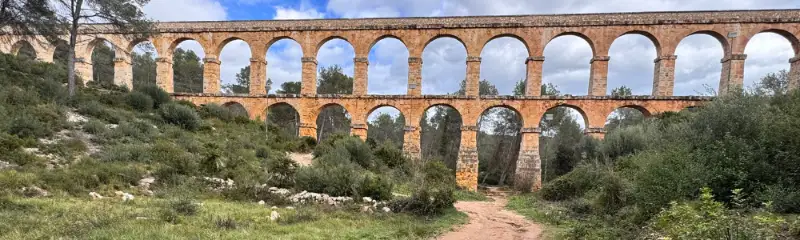
The Ferreres Aqueduct (Pont del Diable)
Water supply was crucial for a city like Tarraco, and the Romans solved this with an impressive engineering feat: the Pont del Diable, an aqueduct that transported water from nearby rivers to the city. Today, this structure still stands, allowing us to cross it on our Defy Tarraco route, just as the inhabitants of Tarraco did two millennia ago.

The Via Augusta: The empire’s highway
If Rome was built with stone, its power was upheld by its roads. The Via Augusta, the largest Roman road in Hispania, ran the entire coast from the Pyrenees to Cádiz, passing through Tarraco. This road allowed for the quick movement of legions, merchants, and imperial messengers. Much of our Defy Tarraco route follows this historic path, connecting us with the past with each kilometer ridden.
Beyond Tarraco: The roman influence in the Province
The Empire left its mark not only in the capital but also throughout the entire province. Our Defy Tarraco route crosses territories that were once part of Roman Hispania.
- Priorat and Montsant: The Romans introduced the vine and the olive tree to these lands, laying the foundations for two of the region’s most iconic products: wine and olive oil.
- Montblanc and Prades: Their roads were traversed by merchants and travelers, forming part of the Empire’s communication network.
- Tortosa: On the banks of the Ebro, this city was an important river port in Roman times, serving as a link between the interior and the Mediterranean.
Following the footsteps of the past
As the route advances, we delve into the interior of Tarragona, where Roman influence remains alive in every hill and gravel road.
Santes Creus y Poblet: The spirit of romanization
The Romans not only left roads and monuments but also marked the land with their rural organization. Centuries later, the monasteries of Santes Creus and Poblet rose as bastions of knowledge and spirituality, inheriting part of the Roman territorial structure.

Montblanc and Prades: Between roads and fortresses:
Montblanc, with its medieval walls, and Prades, the “red village,” guard secrets of ancient roads that may well have been part of old Roman trade routes. This section of the route crosses landscapes that reflect the harshness and beauty of Roman Hispania.

From Priorat to the Via Augusta
The route takes us through the lands of Priorat, where the Romans introduced the vine and olive oil, two pillars of Mediterranean culture. At the Cartoixa d’Escaladei, centuries later, monks perfected this Roman heritage, creating one of the world’s most prestigious wines.
Heading south, we reach the Via Augusta, the great Roman artery that connected Hispania to Rome. Part of our route follows its course, allowing us to experience what ancient travelers felt when traveling this imperial route.
Tortosa and the Ebro Delta: The end of the journey
Upon reaching Tortosa, we encounter a city that was a key point for the Romans, a strategic port that allowed trade and communication with the interior. Finally, the route takes us into the Ebro Delta, where the river and the sea have carved a unique landscape, an environment that was already essential to the economy and supply of the province during Roman times.

Defy Tarraco: A journey through time
More than just a gravel and bikepacking route, Defy Tarraco is an immersive experience in the history of Rome. Pedaling along these roads is to relive the legacy of an Empire that shaped Western history. From the Tarragona Amphitheater to the rural paths of the interior, from bridges and aqueducts to ancient Roman tracks, this adventure is a tribute to the greatness of Tarraco, the city that once was the beacon of Rome in Hispania.
Are you ready to challenge history on two wheels?